
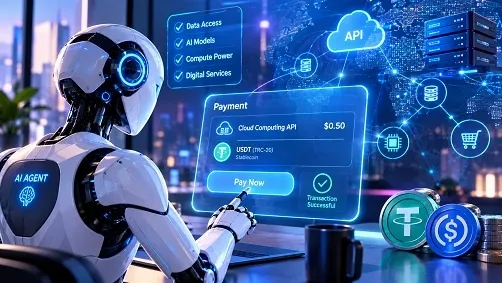
Artificial intelligence is about to enter a new phase.
Until now, most people have interacted with AI as users. We ask a chatbot a question, generate an image, write an email or ask an AI system to analyze information.
But what happens when AI systems stop waiting for humans to approve every individual action?
That is where AI agents enter the picture.
Unlike traditional chatbots, autonomous AI agents can be designed to perform tasks, make decisions and interact with other digital services. And one of the biggest questions emerging in the crypto industry is how these agents will actually pay for the resources they need.
The answer increasingly being discussed is crypto, particularly stablecoins.
The idea sounds futuristic: an AI agent could request an API, pay for computing power, purchase data or access a digital service without a human manually entering a credit card number.
But the technology needed to make this possible is already being developed.
What Are AI Agents?
An AI agent is different from a conventional chatbot.
A chatbot generally responds when a person asks a question. An AI agent can be designed to pursue a goal and perform a sequence of actions to achieve it.
For example, imagine an AI agent responsible for monitoring a company’s online store.
It could:
- Monitor sales data.
- Detect unusual activity.
- Request additional information from an external API.
- Purchase computing resources when necessary.
- Send notifications.
- Interact with other software systems.
- Pay for individual services automatically.
The important difference is that the software is no longer simply generating an answer.
It is becoming an economic actor capable of taking actions.
Why Would AI Agents Need Crypto?
Traditional payment systems were designed primarily around humans and businesses.
A person has a bank account, a credit card or another payment method. A business establishes an account and processes payments through a financial provider.
AI agents create a different problem.
Imagine thousands or millions of autonomous software agents making small transactions throughout the day.
One agent might need to pay a fraction of a dollar for an API request. Another might need to purchase a small amount of computing capacity. A third might need access to a database for several seconds.
Traditional payment infrastructure is not necessarily designed around millions of autonomous machine-to-machine transactions.
Blockchain networks, however, can provide programmable transactions that operate continuously without requiring a human to manually approve every payment.
That is where crypto becomes particularly interesting.
Stablecoins Could Be the Missing Piece
Bitcoin and other volatile cryptocurrencies are not necessarily ideal for pricing everyday machine-to-machine services.
If an AI agent agrees to pay $0.05 for an API request, it would be inconvenient if the value of the payment changed dramatically before the transaction was completed.
Stablecoins solve part of that problem by attempting to maintain a relatively stable value.
Instead of an AI agent holding a volatile asset, it could theoretically hold stablecoins and use them to pay for digital services.
The concept is simple:
AI agent → service request → automatic payment → service delivered.
No human needs to manually enter payment information for every transaction.
The Rise of Machine-to-Machine Payments
This concept is sometimes described as machine-to-machine payments or agentic payments.
The basic idea is that software systems could transact with other software systems automatically.
An AI agent might need access to a weather API. Another might need real-time financial information. A third could require additional computing power.
Instead of purchasing a traditional monthly subscription, the agent could potentially pay only for what it actually uses.
This could create a completely different digital economy.
AI Agents Could Buy Data
Data is one of the most important resources in artificial intelligence.
AI systems may require information from external sources to complete specific tasks. Some of that information can be freely available, while other datasets and APIs are commercial products.
Imagine an AI research agent investigating a particular market.
It discovers that the information it needs is available through a paid API.
Instead of stopping and asking its human operator for payment details, the agent could potentially purchase access automatically using a digital wallet.
The transaction could be tiny.
Perhaps a few cents for one request, a few dollars for a larger dataset or a larger amount for premium computing resources.
This is one reason stablecoins are attracting attention in discussions about the future of AI infrastructure.
AI Agents Could Also Buy Computing Power
Computing resources may be even more important.
Advanced AI models require enormous amounts of processing power. As autonomous agents become more sophisticated, they may need to dynamically obtain additional computing resources.
Consider an AI agent working on a complex task.
It starts with a small amount of computing capacity but realizes that additional processing would significantly reduce the time required to complete the job.
Instead of waiting for a human administrator, the agent could theoretically locate available computing resources, compare prices and purchase additional capacity.
The transaction could happen automatically.
This creates a fascinating possibility:
AI agents could become customers of the digital infrastructure they use.
Why Crypto Fits This Model
There are several characteristics of blockchain technology that make it attractive for this type of experiment.
24/7 Availability
Blockchain networks do not generally operate according to traditional banking hours.
An autonomous agent operating at 3:00 AM could theoretically make a payment without waiting for a bank to open.
Programmable Transactions
Smart contracts can allow payments to be executed according to predefined rules.
This is particularly relevant for software agents because transactions can become part of an automated workflow.
Global Accessibility
Blockchain networks can operate across geographical borders without requiring every participant to use the same traditional banking infrastructure.
Small Transactions
Depending on the network and infrastructure being used, blockchain systems can support transactions designed for digital services and potentially very small payments.
The combination makes crypto an interesting candidate for an economy where software, rather than humans, initiates a growing percentage of transactions.
CoinDesk and BlackRock Are Already Talking About It
This is no longer just a science-fiction concept.
CoinDesk recently examined the question of what AI agents could actually use to operate economically, highlighting the relationship between autonomous software, crypto infrastructure and payments.
BlackRock has also discussed the potential role of digital assets in an economy where AI agents could make payments for data, services and computing resources. The firm’s analysis identifies stablecoins as a particularly relevant technology for automated payments, while also noting that broader agentic commerce remains at an early stage.
That last point is important.
The technology is attracting serious attention, but the economic model is still developing.
The x402 Idea: Paying for the Internet Automatically
One of the concepts receiving attention in this area is x402, a payment protocol designed around HTTP-based payments.
The underlying idea is extremely interesting.
Instead of accessing a digital resource completely for free or purchasing a traditional subscription, a software agent could encounter a payment requirement and automatically pay for access.
For humans, this could be useful.
For autonomous AI agents, it could be transformative.
An agent would not necessarily need to maintain hundreds of different accounts and subscriptions. It could potentially discover a service, determine its price and make a payment when required.
That moves the Internet toward a model where software can negotiate access to digital resources on behalf of its owner.
What Would an AI Crypto Economy Look Like?
Imagine the Internet ten years from now.
You have an AI personal assistant that manages certain digital tasks for you.
It wants to complete a project.
First, it searches for the cheapest reliable data source.
Then it buys access to the information.
It needs additional computing power, so it purchases temporary capacity.
It discovers a specialized AI model that can perform another part of the task and pays for several API calls.
Finally, it pays another service to verify the result.
All of those transactions could potentially happen automatically.
You would not necessarily see every individual payment.
You would simply receive the final result.
That is the vision behind the emerging agentic economy.
But There Is a Huge Problem
There is a major difference between something being technically possible and something being economically practical.
AI agents still have significant limitations.
They can make mistakes. They can misunderstand instructions. They can use incorrect information. They can also be vulnerable to malicious inputs and attacks.
Giving an autonomous agent access to money therefore introduces a completely new category of security problems.
What Happens If an AI Agent Makes a Mistake?
Imagine an agent is instructed to purchase computing resources when necessary.
A software bug causes it to purchase far more resources than intended.
Instead of spending $5, it spends $5,000.
With a traditional human-controlled payment system, fraud detection, spending limits or manual approval may prevent the transaction.
An autonomous crypto wallet could potentially execute the transaction immediately.
This means AI wallets will require sophisticated controls.
Possible safeguards could include:
- Daily spending limits.
- Per-transaction limits.
- Approved service providers.
- Automatic transaction monitoring.
- Human approval for large payments.
- Separate wallets for different AI agents.
- Smart-contract-based spending restrictions.
The challenge is finding the right balance between autonomy and control.
Could AI Agents Become Crypto Users?
This may be the most provocative question.
Cryptocurrency has spent years trying to make ordinary people comfortable with wallets, private keys and blockchain transactions.
But perhaps humans will not be the only important users of crypto.
AI agents may actually be better suited to some aspects of blockchain technology.
A software agent does not need to understand a complicated wallet interface. It can interact directly with an API.
It does not need to remember a password in the same way a human does.
It can monitor transactions continuously.
And it can execute predefined rules much faster than a person.
This creates a strange possibility:
The next major users of crypto might not be humans at all.
What Happens to Traditional Online Payments?
This does not necessarily mean that blockchain will replace credit cards, banks or existing payment networks.
Traditional payment systems are extremely efficient for many human transactions.
The more interesting possibility is that blockchain-based payments could occupy a different layer.
Human purchases could continue using cards and bank transfers.
Meanwhile, autonomous software could increasingly use programmable digital payments for machine-to-machine transactions.
The two systems could coexist.
Why This Could Become a Huge Crypto Narrative
Crypto markets have always been driven partly by narratives.
The combination of AI and crypto has something that makes it particularly powerful: it connects two enormous technology trends.
Artificial intelligence is creating autonomous software.
Blockchain technology provides programmable digital ownership and payment infrastructure.
Stablecoins provide a potential bridge between the two.
That creates a simple story that is easy to understand:
AI agents need money. Crypto gives software a native payment layer.
Whether the vision becomes mainstream remains uncertain, but the idea itself is already attracting significant attention.
AI + Crypto Could Create a New Internet Economy
The most interesting consequence may not be another AI cryptocurrency.
It could be something much bigger.
If AI agents become capable of buying and selling services independently, the Internet could develop an economy in which software continuously exchanges value with other software.
APIs could become marketplaces.
Computing power could become a dynamically priced resource.
Data could be purchased automatically.
AI models could sell their capabilities to other AI systems.
And blockchain networks could provide the settlement layer connecting all of these transactions.
Are We Already Seeing the Beginning?
The infrastructure is still at an early stage, and there are substantial technical and regulatory challenges.
However, the direction of the conversation has changed.
The discussion is no longer simply about using AI to analyze cryptocurrency markets or using blockchain to store AI-generated content.
It is increasingly about whether AI itself can become an economic participant.
That is a much bigger idea.
Final Thoughts
AI agents and cryptocurrency may seem like two completely different technologies.
One is about intelligence and automation.
The other is about digital ownership, payments and decentralized networks.
But autonomous software creates a problem that crypto may be unusually well positioned to solve: how can machines pay other machines?
Stablecoins, blockchain networks and programmable payments could provide part of the answer.
The technology is still developing, and many of the most ambitious ideas remain experimental. But the combination of AI agents and crypto has already become one of the most interesting narratives in the digital economy.
The biggest change may come when an AI agent stops being something that simply answers your questions and becomes something that can independently buy the resources it needs to complete a task.
When AI can think, act and pay, the Internet could start looking very different.
And that may be the real beginning of the AI-powered crypto economy.
This article is for informational purposes only and does not constitute financial advice. Cryptocurrency markets are highly volatile, and digital assets can involve a substantial risk of loss.