What if buying a stock started to feel more like buying cryptocurrency?
Instead of opening a traditional brokerage account, waiting for conventional market hours and relying entirely on centralized financial infrastructure, investors could eventually trade tokenized versions of stocks directly on blockchain-based markets.
This idea has been discussed for years. But in September 2026, it moved significantly closer to reality in the United States.
On September 17, 2026, the U.S. Securities and Exchange Commission (SEC) announced a temporary “Innovation Exemption” allowing certain blockchain-based trading venues to facilitate trading in tokenized National Market System stocks under specified conditions. The exemption is designed to last five years and is subject to limits and investor-protection requirements.
That development could become one of the most important moments in the convergence between traditional finance and crypto.
Because this is no longer just about putting a stock logo on a blockchain token.
The underlying question is whether part of the traditional stock market could actually move on-chain.
What Are Tokenized Stocks?
A tokenized stock is a digital representation of a traditional security recorded and transferred using blockchain or distributed-ledger technology.
The concept sounds simple, but there is an important distinction between a genuine tokenized security and a synthetic token that merely attempts to track the price of a stock.
Under the SEC’s new framework, eligible tokenized NMS stocks must provide holders with the same rights and privileges as the equivalent traditional stock, including rights related to dividends and voting. The framework also excludes synthetic versions that simply provide price exposure without representing the underlying security in the required way.
That distinction is extremely important.
Imagine that you buy a token representing one share of a company.
In a genuine tokenization model, the token is intended to represent the actual security and its associated rights rather than simply being a cryptocurrency that happens to follow the company’s stock price.
Why Is the SEC’s Decision So Important?
The significance of the September 2026 announcement is not simply that another financial product can now use blockchain.
The SEC is effectively creating a temporary regulatory framework under which certain Tokenized Securities Venues, or TSVs, can operate without being treated as traditional exchanges under a specific provision of the Securities Exchange Act, provided they satisfy the conditions of the exemption.
The framework also provides conditional relief for certain liquidity providers participating in automated market-maker liquidity pools.
In other words, the SEC is allowing a controlled experiment.
Blockchain-based stock trading can take place under a defined set of rules while regulators observe how the market develops.
The exemption is temporary rather than a permanent rewrite of securities law. The SEC says it will expire five years after publication and has requested public comment about possible modifications and future regulatory steps.
Wall Street Meets Crypto Infrastructure
Traditional stock markets and cryptocurrency markets have historically operated using very different infrastructure.
Stocks are generally traded through regulated exchanges, brokerages, clearing systems, custodians and other financial intermediaries.
Crypto markets, by contrast, introduced blockchain-based settlement, self-custody, digital wallets and smart contracts.
Tokenization attempts to bring some of those blockchain characteristics into traditional financial markets.
That could eventually create markets where the distinction between “traditional finance” and “crypto” becomes increasingly difficult to define.
The SEC itself describes the exemption as a step toward bringing U.S. capital markets into the digital age and facilitating on-chain trading of certain tokenized stocks.
Could Stocks Really Trade 24/7?
This is one of the most exciting possibilities surrounding tokenized equities.
Traditional stock exchanges have historically operated during defined market hours, although extended-hours trading has expanded considerably.
Blockchain networks, however, can operate continuously.
That creates the possibility of financial markets functioning much closer to a 24/7 model.
It is important not to confuse this possibility with the current SEC framework. The exemption establishes conditions for specific on-chain trading venues; it does not simply declare that every U.S. stock can now trade around the clock.
Nevertheless, the underlying technology makes continuous trading technically conceivable.
And the financial industry is already moving toward longer trading hours. For example, Reuters reported on September 29 that Robinhood plans to introduce 24-hour weekend trading for a selected group of U.S. stocks and ETFs, subject to regulatory approval.
The direction is clear: financial markets are increasingly experimenting with ways to reduce the traditional boundaries between market hours.
Why Would Anyone Want Stocks on a Blockchain?
There are several potential reasons.
1. Faster Settlement
Blockchain systems can record transactions and ownership changes directly on a distributed ledger.
This could reduce some of the complexity associated with traditional post-trade processes.
Instead of having multiple systems communicating with one another, certain parts of the transaction lifecycle could potentially be represented on the same programmable infrastructure.
2. Greater Transparency
Public blockchains can make transaction data visible and independently verifiable, although the exact level of transparency depends on how a particular tokenized market is designed.
The SEC’s framework specifically includes requirements around public information concerning operations and trading activity. It also requires certain transaction data to be made publicly available at regular intervals.
3. Programmability
A blockchain token can interact with smart contracts.
This opens the door to automated financial applications in which tokenized securities could interact with lending protocols, settlement systems, trading platforms or other digital infrastructure.
The stock would no longer exist only as an entry inside a traditional financial database.
It could become a programmable digital asset.
4. Fractional Ownership
Tokenization can make it easier to represent fractions of assets.
Fractional ownership is not exclusive to blockchain, but digital tokens can provide a standardized mechanism for representing ownership units.
This could become particularly interesting for assets that are difficult to divide or transfer using traditional infrastructure.
What Makes the New SEC Framework Different?
The SEC has not simply opened the door to any cryptocurrency claiming to represent a stock.
The Innovation Exemption contains several conditions designed to control how tokenized NMS stocks can be traded.
Among other requirements:
- Tokenized stocks are subject to limits on symbols and trading volume.
- Eligible tokenized stocks must provide holders with the same rights and privileges as the corresponding traditional stock.
- Issuers must have an opportunity to object when an unaffiliated third party wants to tokenize their stock.
- Smart contracts used by the relevant trading venues must be auditable and public.
- The smart contracts must be deployed on a public, permissionless distributed ledger.
- Trading in the tokenized stock must stop when trading in the underlying stock is stopped on its primary listing exchange.
- Trading venues must provide public information about their operations and trading activity.
These conditions are significant because they demonstrate that tokenization is being treated as a securities-market issue rather than simply another cryptocurrency product.
Tokenized Stocks vs. Synthetic Stocks
The difference between these two concepts is easy to overlook.
A tokenized stock is intended to represent an actual security within the applicable legal and market structure.
A synthetic stock token can instead provide exposure to the price of a stock without giving the holder the same ownership rights as the underlying equity.
Imagine two tokens.
Token A represents an actual tokenized share and is structured to provide the corresponding shareholder rights.
Token B simply tracks the price of the same company.
If the company’s stock rises by 10%, both tokens might theoretically rise by roughly the same amount.
But economically and legally, they can be completely different products.
The SEC’s Innovation Exemption specifically excludes synthetic versions from the eligible tokenized NMS stock framework.
Could Tokenized Stocks Replace Traditional Brokerages?
That is one of the most provocative questions.
Probably not in the immediate future.
Traditional brokerages perform many functions beyond simply allowing someone to buy a stock.
They handle custody, compliance, identity verification, reporting, customer accounts, tax documentation and other services.
Tokenization does not automatically eliminate those requirements.
Instead, it could change the technological layer underneath some of those services.
The more interesting possibility is that traditional brokerages and crypto platforms could begin competing for the same customers.
A crypto exchange could potentially offer stocks.
A traditional brokerage could offer blockchain-based securities.
And users may eventually stop caring which category a platform belongs to.
Crypto Exchanges Want Into the Stock Market
The convergence is already visible.
Major crypto companies have expressed interest in tokenized stocks, while platforms such as Robinhood and Kraken have offered forms of tokenized stock products outside the United States.
Reuters reported that Coinbase has signaled plans to launch tokenized stocks in the United States when the regulatory environment allows it, while several platforms have already experimented with these products in other jurisdictions.
This creates an unusual situation.
For years, traditional financial companies moved toward crypto.
Now crypto companies are moving toward traditional financial assets.
The two worlds are meeting in the middle.
What Would a Tokenized Stock Market Look Like?
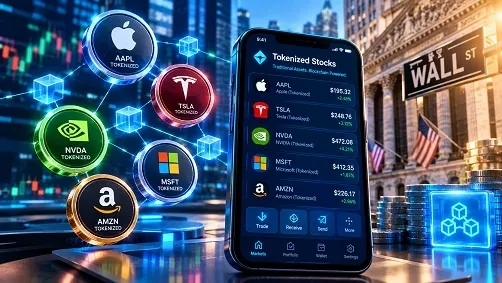
Imagine opening a digital wallet.
Inside it, instead of only seeing Bitcoin, Ethereum or stablecoins, you might see tokenized shares of publicly traded companies.
You could potentially move those assets between compatible platforms, subject to the applicable rules.
You could interact with decentralized or automated financial applications.
You could potentially use the tokens as collateral.
And the ownership record could exist directly on a blockchain.
This is the broader vision behind financial tokenization.
Stocks are only one possible category.
Real Estate Could Follow
If stocks can be represented on blockchain infrastructure, the same basic technology could potentially be applied to other financial and real-world assets.
Real estate is an obvious example.
Private credit, bonds, funds and other financial instruments are also being examined through the lens of tokenization.
The underlying concept is always similar:
Take an asset that traditionally exists inside a centralized financial system and represent its ownership or economic rights digitally on a blockchain.
The challenge is making the legal rights, custody arrangements and technological representation match.
The Self-Custody Question
One of the most controversial ideas surrounding tokenized stocks is self-custody.
Crypto demonstrated that individuals can hold digital assets directly in wallets rather than relying entirely on a centralized custodian.
If securities eventually adopt similar infrastructure, investors could potentially gain greater control over how their assets are held and transferred.
However, securities are not simply cryptocurrencies with a different logo.
Ownership rights, investor protections, corporate actions and regulatory requirements all matter.
That is why the SEC framework requires tokenized stocks covered by the exemption to maintain the same rights and privileges as their traditional counterparts.
What About Dividends?
This is another area where tokenization becomes particularly interesting.
A traditional shareholder may receive dividends from a company.
A genuine tokenized representation of that security must preserve the applicable rights.
This means tokenized securities cannot simply be treated as speculative digital objects detached from the underlying company.
The financial relationship with the issuer still matters.
That is one of the biggest differences between tokenized securities and many ordinary crypto tokens.
Could Tokenized Stocks Be Traded Around the World?
Blockchain technology is inherently global.
Regulation is not.
This creates one of the biggest challenges for tokenized financial markets.
A blockchain can operate globally, but securities laws depend on jurisdictions.
A token representing a U.S. stock may be subject to U.S. securities regulations. A European investor may be subject to additional European rules. Other jurisdictions may have completely different requirements.
Therefore, a global tokenized stock market cannot simply ignore national regulations.
The technology may be global, but the legal infrastructure remains fragmented.
The Liquidity Problem
Another major question is liquidity.
Traditional stock markets have enormous amounts of trading activity concentrated in established venues.
A new tokenized market may initially have much less liquidity.
That can create wider spreads and more significant price movements, particularly outside traditional market hours.
Liquidity is especially important for automated market makers and liquidity pools because prices can behave differently when relatively little capital is available.
The SEC’s framework therefore includes trading and volume limits as part of the conditions surrounding the exemption.
Security Will Become Even More Important
Tokenization also creates new technical risks.
A traditional financial system can suffer from operational failures, cyberattacks and fraud.
A blockchain-based system introduces additional risks involving wallets, private keys, smart contracts and blockchain infrastructure.
If a smart contract contains a vulnerability, the consequences could potentially be significant.
That is why the SEC requires smart contracts used by TSVs under the exemption to be auditable and public.
Transparency does not eliminate risk, but it can make independent examination of the technology possible.
Will Tokenized Stocks Make Markets Faster?
Potentially.
But “faster” does not automatically mean “better.”
Financial markets depend on more than transaction speed.
They require accurate pricing, sufficient liquidity, reliable settlement, investor protections and mechanisms for dealing with errors and market disruptions.
Moving transactions onto a blockchain may improve certain processes while creating new challenges elsewhere.
The important question will therefore be whether tokenization can improve the entire market structure rather than simply making individual transactions faster.
The 24/7 Stock Market Is Getting Closer
The idea of a stock market that never closes has fascinated investors for years.
Crypto markets already operate continuously.
Now traditional finance is increasingly experimenting with longer trading windows.
Robinhood’s announcement of planned 24-hour weekend trading for selected U.S. stocks and ETFs is another indication of where the industry is heading, although that specific service is subject to regulatory approval.
Tokenization could eventually reinforce that trend because blockchain infrastructure is designed for continuous digital transactions.
Imagine breaking news arriving at 2:00 AM on a Saturday.
In a traditional market, investors may have to wait for the relevant trading session.
In a sufficiently developed 24/7 tokenized market, trading could potentially continue.
Whether that would improve markets or simply create new risks is a separate question.
What Happens to Market Opening Bells?
For centuries, financial markets have been built around opening and closing times.
Crypto challenged that model.
Tokenized securities could challenge it again.
Instead of thinking about a market as something that opens at a particular time, investors could eventually think about financial markets as permanent digital infrastructure.
The distinction between weekdays and weekends could become less important.
Global investors could interact with markets whenever they are open to them.
That would represent a significant cultural change in addition to a technological one.
Is Wall Street Really Moving On-Chain?
The answer depends on what “moving on-chain” means.
Wall Street is not suddenly abandoning traditional exchanges, banks or financial infrastructure.
But regulators and financial companies are increasingly experimenting with blockchain-based versions of traditional assets and market infrastructure.
The SEC’s September 2026 Innovation Exemption is concrete evidence of that shift.
The framework allows limited on-chain trading of qualifying tokenized NMS stocks under a temporary and conditional structure.
That is a meaningful change from simply discussing tokenization as a theoretical possibility.
The Biggest Question: Will Companies Want Their Stocks Tokenized?
Technology alone cannot determine the future of tokenized equities.
Issuers matter too.
Under the SEC’s framework, when a third party tokenizes an underlying stock, the issuer must receive notice and an opportunity to object before that tokenized stock is made available for trading on the relevant venue.
This gives companies an important role in determining whether their securities participate in the new market structure.
If large numbers of major companies embrace tokenization, the market could develop rapidly.
If issuers remain cautious, adoption could be much slower.
What Could Happen Next?
The next few years could be extremely important for tokenized securities.
Several developments will be worth watching:
- Which companies allow their shares to be tokenized.
- Which trading platforms receive regulatory approval.
- How much liquidity develops on tokenized markets.
- Whether investors actually demand 24/7 stock trading.
- How dividends and voting rights are handled digitally.
- Whether tokenized stocks become interoperable across platforms.
- How regulators in Europe and other major markets respond.
- Whether tokenized securities become integrated with decentralized finance.
The answers to those questions will determine whether tokenized stocks remain a niche financial experiment or become a major part of global markets.
Why This Matters for Crypto
For the cryptocurrency industry, tokenized stocks represent something much bigger than another category of token.
They could bring traditional financial assets directly into blockchain ecosystems.
That means crypto wallets, stablecoins, decentralized applications and tokenized securities could eventually interact within the same digital environment.
Imagine holding stablecoins in one wallet, using them to purchase a tokenized stock, using that stock as collateral and then interacting with another financial application — all through programmable infrastructure.
That is the broader vision of an on-chain financial system.
The Bigger Picture
Financial markets have always evolved alongside technology.
Paper certificates were replaced by electronic records.
Physical trading floors were supplemented by computerized systems.
Online brokerages transformed retail investing.
Now blockchain technology is challenging another assumption: that financial ownership and trading must be represented through traditional centralized databases.
Tokenized stocks are an attempt to test what happens when those records become programmable blockchain assets.
The experiment is still young.
The SEC’s five-year exemption is explicitly temporary, and the agency is requesting public feedback while it evaluates the market and considers future rules.
Conclusion: The Stock Market May Be Entering Its Crypto Era
Tokenized stocks are no longer just a futuristic idea.
The United States has now created a temporary regulatory path for certain on-chain trading of tokenized NMS stocks, subject to significant conditions and investor protections.
The technology could eventually make stocks more programmable, enable new forms of trading and connect traditional securities with blockchain-based financial infrastructure.
It could also create new risks involving liquidity, cybersecurity, smart contracts, regulation and automated trading.
There is no guarantee that tokenized stocks will replace traditional equities markets.
But something important has already happened.
The conversation has moved from “Can stocks exist on blockchain?” to “How should blockchain-based stock markets actually work?”
That is a very different question.
And if tokenized securities continue to gain regulatory acceptance, the next generation of investors may eventually look at the distinction between “stocks” and “crypto” as an outdated one.
The real transformation may not be that Wall Street becomes crypto.
It may be that the blockchain quietly becomes part of Wall Street.
This article is for informational purposes only and does not constitute financial, investment or legal advice. Tokenized securities, cryptocurrencies and other digital assets involve risks, including market, liquidity, regulatory, technology and cybersecurity risks.